How to Calculate Square Meter of an L-Shaped Room
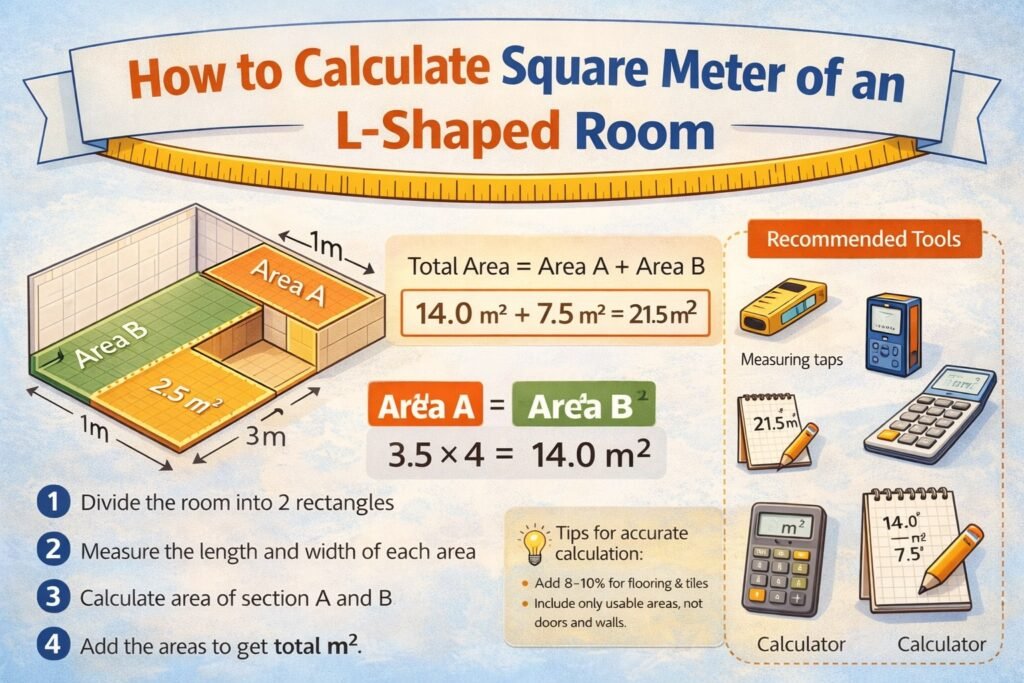
How to calculate square meter of an L-shaped room is a common challenge for homeowners, renovators, designers, and professionals working with non-standard layouts. Unlike rectangular rooms, an L-shaped room cannot be measured with a single formula. Without a clear method, measurements can become inaccurate, leading to incorrect material orders and budget overruns.
This guide explains how to calculate square meter of an L-shaped room using a simple, reliable approach that works for renovation planning, flooring, painting, and interior design. The method is practical, easy to apply, and suitable for both personal and professional projects.
Why L-Shaped Rooms Require a Different Calculation Method
An L-shaped room is not a single continuous rectangle. It consists of two connected rectangular sections that form an “L” shape. Because of this layout, multiplying one length by one width does not reflect the real surface area.
Understanding how to calculate square meter correctly ensures that:
- Flooring quantities are accurate
- Paint and materials are not wasted
- Renovation costs remain controlled
- Contractors and suppliers work with the same numbers
Precision is especially important in kitchens, living rooms, and open-plan spaces where L-shaped layouts are common.
What Is a Square Meter?
A square meter (m²) is a unit of area representing a surface that measures one meter by one meter. It measures surface area, not length or height.
When calculating room size, square meters are used to determine how much floor, wall, or usable surface exists. This unit is standard in most countries and is essential for renovation and real estate planning.
Tools Needed to Calculate Square Meter of an L-Shaped Room
You do not need complex equipment. Accuracy comes from method, not tools.
Recommended tools:
- Measuring tape in meters
- Laser distance meter (optional)
- Notebook or phone notes
- Calculator
- Simple sketch of the room
Always measure twice to avoid errors.
How to Calculate Square Meter of an L-Shaped Room – Core Method
The most reliable way to calculate an L-shaped room is to divide it into smaller rectangles.
The method follows four clear steps:
- Divide the room into two rectangular sections
- Measure the length and width of each section
- Calculate the area of each rectangle
- Add the areas together
This approach eliminates guesswork and works for any L-shaped layout.
Step 1: Divide the L-Shaped Room Into Rectangles
Visually split the room into two rectangles. These rectangles should cover the entire floor area without overlapping.
It does not matter if the rectangles are equal or different sizes. What matters is that together they represent the full L-shaped surface.
This step is the foundation of how to calculate square meter accurately.
Step 2: Measure Each Section Carefully
Measure each rectangle separately.
For every section:
- Measure the length in meters
- Measure the width in meters
Always measure wall to wall and exclude skirting boards. Write the measurements clearly to avoid confusion later.
Step 3: Calculate the Area of Each Rectangle
For each rectangle, multiply the length by the width to get the area in square meters.
Example:
- Rectangle A: 3.5 meters by 4.0 meters
Area A equals 14.0 square meters - Rectangle B: 2.5 meters by 3.0 meters
Area B equals 7.5 square meters
Each rectangle is calculated independently.
Step 4: Add the Areas Together
Add the areas of both rectangles to get the total surface.
In the example:
- Area A: 14.0 square meters
- Area B: 7.5 square meters
Total area equals 21.5 square meters.
This final number represents the full floor area of the L-shaped room.
Practical Example: Kitchen With an L-Shaped Layout
Many kitchens follow an L-shaped design.
If a kitchen has:
- Main area: 4.0 × 3.0 meters
- Extension area: 2.0 × 2.5 meters
The calculations are:
- Main area: 12.0 square meters
- Extension area: 5.0 square meters
Total kitchen area equals 17.0 square meters.
This method is essential for planning cabinetry, flooring, and appliances.
How to Calculate Square Meter of an L-Shaped Room for Flooring
Flooring requires extra precision because cuts and waste are unavoidable.
After calculating the total square meters:
- Add 5–10 percent for laminate
- Add 8–10 percent for parquet
- Add 10–15 percent for tiles
For example, if the L-shaped room measures 21.5 square meters, adding a 10 percent allowance brings the required order to approximately 23.7 square meters.
This step prevents material shortages during installation.
How to Calculate Square Meter of an L-Shaped Room for Painting
When painting, floor area is not enough. You must calculate wall surfaces.
The process is:
- Measure wall height
- Measure the length of each wall section
- Multiply height by length for each wall
- Add all wall areas together
- Subtract doors and windows
Although the room is L-shaped, walls are measured linearly, section by section.
How to Handle Alcoves and Niches in L-Shaped Rooms
Some L-shaped rooms include alcoves or recessed areas.
If the alcove is usable floor space, include it as a small rectangle and add it to the total. If it is structural or blocked, exclude it.
Consistency matters more than size when calculating.
Common Mistakes When how to calculate square meter of an L-shaped room
Errors often come from assumptions, not tools.
Avoid these mistakes:
- Treating the room as a single rectangle
- Estimating instead of measuring
- Forgetting small extensions
- Mixing centimeters and meters
- Rounding numbers too early
Each mistake can affect final material quantities.
Metric and Imperial Units in L-Shaped Room Calculations
Some tools or plans may use feet instead of meters.
If measurements are in feet, convert them before calculating. One square meter equals approximately ten point seven six square feet.
Always use one unit system throughout the calculation to avoid confusion.
Professional Approach to L-Shaped Room Measurements
Professionals follow a structured process:
- Draw a quick sketch
- Divide the room logically
- Measure each section twice
- Calculate areas separately
- Add results carefully
This process ensures accuracy and credibility when sharing measurements with clients or suppliers.
When to Recheck Your Measurements
Recheck measurements if:
- Results seem unusually high or low
- Walls are not straight
- The room includes structural columns
- Multiple materials depend on the calculation
Double-checking saves time and money later.
Internal Links for Measurement Context
For a complete understanding of room measurements, see:
how to calculate square meter of a roomsmall kitchen renovation projectsbudget renovation planningThese resources help apply measurements in real renovation scenarios.
FAQ – How to Calculate Square Meter of an L-Shaped Room
Divide the room into two rectangles, calculate each area separately, and add the results together.
Yes. One person can measure accurately using a tape measure and a simple sketch.
No. Only include usable floor area unless planning flooring under cabinets.
Yes. Dividing into rectangles works for all L-shaped layouts.
Yes. Always add a waste allowance depending on the flooring material.
Final Thoughts for how to calculate square meter of an L-shaped room
Knowing how to calculate square meter of an L-shaped room removes uncertainty from renovation and planning. By breaking the room into simple sections, anyone can measure accurately and confidently. This method works for homeowners, professionals, and businesses alike and prevents costly mistakes before they happen.
Once mastered, this approach becomes a standard tool for any non-rectangular space.
⭐ Featured Businesses in

Alexandre Canopy & Verandas
Alexandre Canopy & Verandas is a specialist provider of premium canopy verandas, pergolas, and glass outdoor…
View profile →
Printelina.com
Printelina is a creative digital brand focused on visual storytelling through motivational art, design, and print-ready…
View profile →
Renovari.Net
Renovari.net is a professional online platform dedicated to home renovations and construction services. We connect homeowners…
View profile →