Square Meter vs Square Feet – Complete Guide
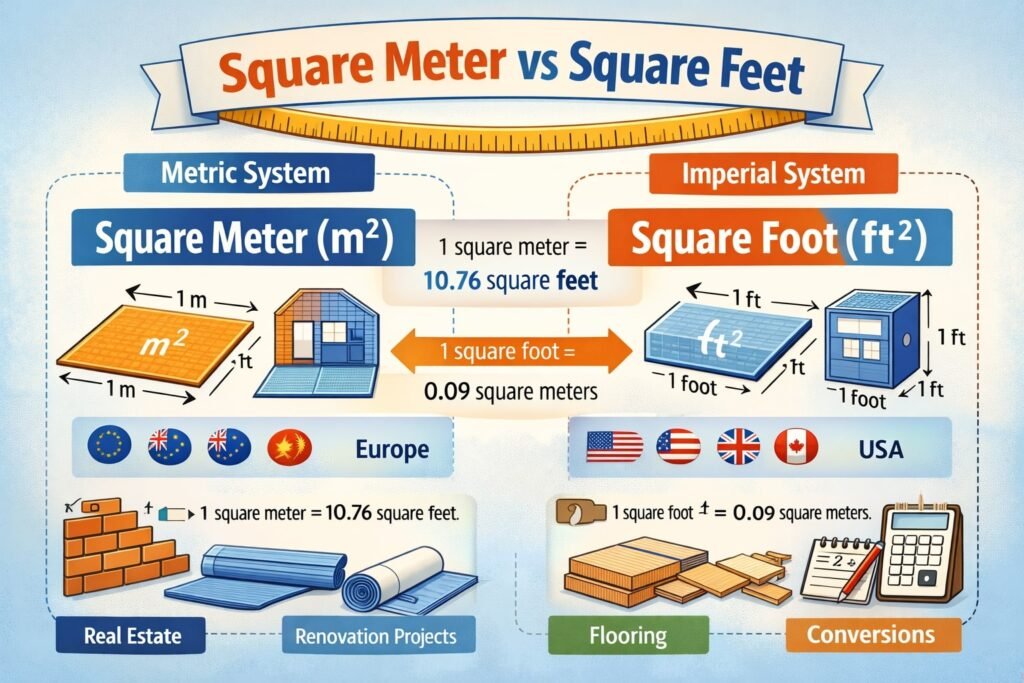
Square Meter vs Square Feet is a fundamental topic for anyone working with property sizes, renovations, interior planning, or international projects. When measurements are misunderstood, costs increase, materials are wasted, and decisions are delayed. This article explains Square Meter vs Square Feet in a clear, structured, and practical way, following Yoast SEO recommendations and the editorial style already used on globalbusinesscard.online.
Whether you are a homeowner, freelancer, contractor, consultant, or business owner, understanding Square Meter vs Square Feet helps you communicate professionally and avoid costly errors.
What Is a Square Meter?
A square meter (m²) is the standard unit of area in the metric system. It represents the surface of a square that measures one meter on each side.
In practical terms, one square meter equals an area of one meter multiplied by one meter. Square meters are used in most countries around the world, especially in Europe, Asia, Australia, and Africa. In construction, architecture, and real estate, square meters are the default unit for measuring room sizes, apartments, and buildings.
Understanding this definition is essential before comparing Square Meter vs Square Feet.
What Is a Square Foot?
A square foot (ft²) is a unit of area in the imperial measurement system. It represents the surface of a square that measures one foot on each side.
Square feet are commonly used in the United States and in some international real estate listings. While the concept is similar to a square meter, the size is significantly smaller, which is why direct numerical comparisons are misleading without conversion.
This difference is at the core of the Square Meter vs Square Feet comparison.
Square Meter vs Square Feet – The Core Difference
The most important distinction in Meter vs Feet is scale.
One square meter is much larger than one square foot. This means that the same room will always have a smaller numerical value when measured in square meters and a larger numerical value when measured in square feet.
In exact terms, one square meter equals approximately ten point seven six square feet. Conversely, one square foot equals approximately zero point zero nine square meters.
This difference explains why international listings can look confusing at first glance.
Meter vs Feet Conversion Explained Simply
To convert square meters into square feet, multiply the number of square meters by ten point seven six.
To convert square feet into square meters, multiply the number of square feet by zero point zero nine.
These conversions are essential when working across borders or comparing supplier data, and they form the practical foundation of Meter vs Feet understanding.
Square Meter vs Feet in Real Estate Listings
Real estate platforms often use different measurement systems depending on country and audience.
In Europe, apartment sizes are almost always shown in square meters. In the United States, the same apartment would be listed in square feet. Without knowing the conversion, buyers and renters may overestimate or underestimate the actual space.
For example, an apartment listed as eighty square meters may sound small to an international buyer. However, when converted, it equals over eight hundred sixty square feet, which is considered a comfortable size in many markets.
This real-world scenario shows why Meter vs Feet knowledge is essential in property evaluation.
Square Meter vs Square Feet for Renovation Planning
Renovation planning requires precise area calculations. Flooring, painting, insulation, and heating systems all depend on surface measurements.
If a contractor provides estimates in square meters but materials are sold in square feet, or vice versa, conversions must be made before ordering. Failure to do so can lead to material shortages or overspending.
Understanding Meter vs Feet ensures that all calculations remain consistent and reliable throughout the project lifecycle.
Square Meter vs Square Feet in Flooring Projects
Flooring suppliers often operate internationally. Some list prices per square meter, while others list per square foot.
For example, if a room measures twenty-five square meters, converting it to square feet gives approximately two hundred sixty-nine square feet. Ordering flooring without conversion could result in incorrect quantities and delays.
This practical example highlights how Meter vs Feet directly affects costs and logistics.
Square Meter vs Square Feet in Construction and Architecture
Architectural drawings and construction plans may follow either metric or imperial standards. Mixing the two systems without conversion leads to errors in execution and budgeting.
Professionals always standardize measurements before starting calculations. They convert everything into one system, verify dimensions, and then estimate costs.
This professional approach is based entirely on a correct understanding of Meter vs Feet.
Square Meter vs Square Feet for Interior Design and Furniture Layout
Interior designers often work with furniture dimensions listed in centimeters or inches, while room sizes are listed in square meters or square feet.
To plan layouts accurately, designers convert all measurements into a single system. This allows them to calculate circulation space, placement, and balance.
Without clarity on Meter vs Feet, even experienced designers risk misjudging scale.
Common Mistakes When Comparing Square Meter vs Square Feet
Several errors appear frequently in international projects.
One common mistake is assuming that numbers are comparable without conversion. Another is confusing linear measurements with surface area. Rounding too early in calculations is also a frequent issue that leads to inaccuracies.
Avoiding these mistakes starts with a solid understanding of Meter vs Feet and consistent unit usage.
Which Measurement System Should You Use?
The choice between square meters and square feet depends on context, not preference.
If your suppliers, contractors, and local regulations use metric units, square meters are the correct choice. If you operate in a market that uses imperial units, square feet may be more practical.
What matters most is consistency. Mixing systems without conversion creates confusion and risk. This principle applies in every Meter vs Feet scenario.
Quick Estimation Tips for Square Meter vs Square Feet
For fast mental estimates on site or during calls, you can use approximations.
To estimate square feet from square meters, multiply by eleven. To estimate square meters from square feet, divide by eleven. These shortcuts are not exact but useful for quick decisions.
Even professionals rely on these methods when speed matters.
FAQ – Square Meter vs Square Feet
Square meters and square feet are both units of area, but one square meter is much larger than one square foot.
Yes. One square meter equals approximately ten point seven six square feet.
Because they follow the imperial measurement system instead of the metric system.
Yes, but only after proper conversion to avoid calculation errors.
Either unit works as long as all calculations are consistent and correctly converted.
Final Thoughts on Square Meter vs Square Feet
Understanding Meter vs Feet is no longer optional in a global business and renovation environment. Properties, services, and materials cross borders daily, and accurate measurement knowledge protects budgets, timelines, and professional credibility.
Once you master the difference and conversion between square meters and square feet, you eliminate confusion and gain confidence in every international project, listing, or renovation decision.
Find more
small kitchen renovation projects small kitchen renovation projects budget renovation planning updating interiors using accurate measurements⭐ Featured Businesses in

Alexandre Canopy & Verandas
Alexandre Canopy & Verandas is a specialist provider of premium canopy verandas, pergolas, and glass outdoor…
View profile →
Printelina.com
Printelina is a creative digital brand focused on visual storytelling through motivational art, design, and print-ready…
View profile →
Renovari.Net
Renovari.net is a professional online platform dedicated to home renovations and construction services. We connect homeowners…
View profile →